
NAPCO Refinisher

What Commercial Property Managers Expect from Refinishers (That Homeowners Don’t)
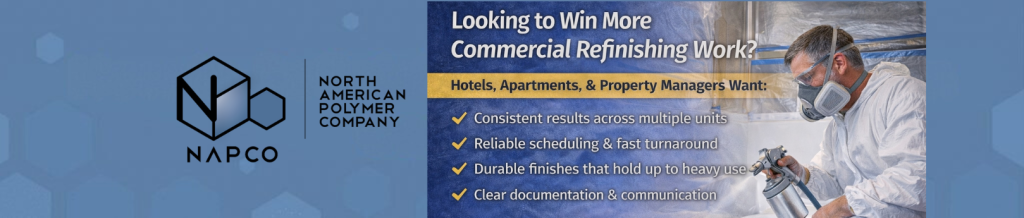
Residential refinishing clients and commercial clients both want clean, durable results, but they define success in different ways. Homeowners think in terms of personal taste and one-time projects. Commercial clients think in systems, schedules, and repeatable outcomes.
Understanding that shift in mindset is what separates a contractor who occasionally takes commercial work from one who becomes a trusted vendor.
For professional refinishers looking to expand into hotels, apartment communities, healthcare facilities, or senior housing, that distinction is critical. Commercial buyers are not simply purchasing a finish. They are evaluating risk, reliability, and whether your service integrates smoothly into their property management systems.
Commercial Work Focuses on Consistency, Not Customization
Homeowners often want finishes that reflect personal style, whether that means a specific color, texture, or sheen.
Commercial clients usually place greater value on uniformity. A hotel or apartment complex needs every tub, shower, or countertop to look the same from unit to unit. The goal is predictability rather than personality.
Contractors who can reproduce the same finish across many spaces bring added value by delivering results that stay consistent from project to project.
For refinishers, this means developing standardized application procedures, documented prep processes, and repeatable color matching systems. Commercial clients want to know that Unit 204 will match Unit 312 six months later. That level of replication builds trust and often leads to recurring contracts rather than one-off projects.
Speed and Scheduling Drive Every Decision
In residential work, a delay may be inconvenient.
In commercial environments, it can interrupt daily operations. Vacant units must be prepared quickly, hotel rooms need to return to service, and retail and healthcare settings cannot accommodate extended downtime. Commercial clients expect refinishing processes that fit within tight windows and fixed schedules.
They care less about the method and more about whether the work supports the flow of their business.
Professional refinishers who succeed commercially often refine their workflow around turnaround efficiency. That includes predictable cure times, coordinated staging, and communication that aligns with property turnover schedules. Being able to say, “This room will be ready by 3 p.m. tomorrow,” and delivering on it consistently is often more valuable than decorative customization.
Performance Comes Before Appearance
A homeowner may decide a job is successful based on how a surface looks under bathroom lighting, while commercial clients measure success by how it performs day-after-day.
Their focus is durability in high-traffic environments, where cleaning is more aggressive and use is constant. Finishes have to withstand real wear, not just light household conditions, which means products and application methods that work well in residential spaces may need to meet tougher performance standards in commercial settings.
For refinishers, this shifts the conversation toward coating systems, adhesion strength, chemical resistance, and long-term maintenance compatibility. Commercial buyers are thinking about housekeeping carts, repeated chemical cleaning, tenant turnover, and warranty expectations. Demonstrating knowledge of those realities positions you as a professional vendor rather than simply a skilled tradesperson.
They Look for Long-Term Partners
Homeowners typically approach refinishing as a focused project for one space, while commercial clients plan for groups of properties and longer-term upkeep.
That difference shapes what they look for in a contractor. Property managers and facilities teams appreciate partners who can provide dependable results across multiple projects, supported by clear records and consistent communication.
The craftsmanship remains important, and the ability to align with their operational needs is part of what builds lasting working relationships.
For refinishers targeting multifamily portfolios or hospitality groups, relationship-building becomes just as important as surface preparation. Follow-up, documentation, scheduling reliability, and responsiveness create vendor status that can generate recurring revenue year after year.
Clearer Processes
Commercial projects typically involve defined scopes of work, set timelines, and detailed product specifications, which help teams plan, budget, and coordinate across properties.
Records may be needed for internal approvals, maintenance schedules, or vendor requirements, so clear documentation becomes part of the service itself.
Homeowners may focus more on visual samples and final results, while commercial clients balance those same results with operational needs.
Professional refinishers who thrive commercially often create simple process documentation: prep steps, product systems used, cure times, maintenance guidelines, and warranty terms. That transparency reduces friction and makes facilities managers more comfortable approving repeat work.
Why These Expectations Shape the Work
The skills used in residential refinishing carry over naturally into commercial projects, but the context in which they are applied is broader.
Instead of focusing on a single upgrade, commercial clients plan for consistency, dependable performance, and support that fits into their day-to-day operations.
When contractors understand that shift, they can present their services in ways that match how commercial buyers evaluate success.
For refinishing professionals, the opportunity is significant. Commercial accounts often provide volume, repeat business, and predictable scheduling when managed properly. The contractors who recognize the difference in expectations and adjust their positioning, communication, and systems accordingly—are the ones who transition from occasional commercial jobs to trusted vendor relationships.
Commercial Refinishing FAQ for Professional Contractors
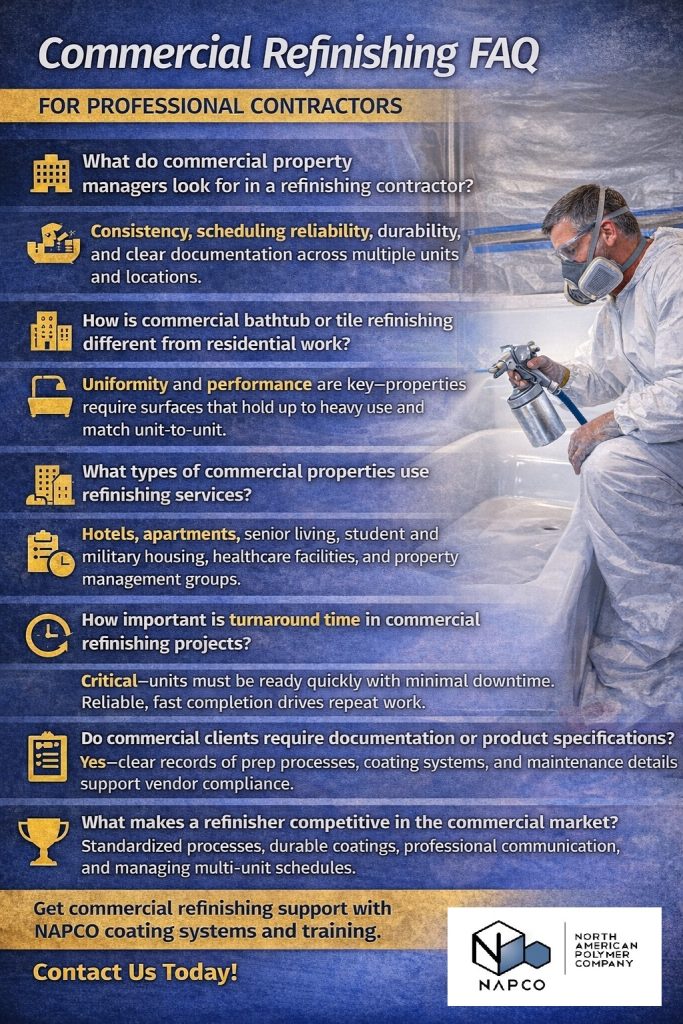
What do commercial property managers look for in a refinishing contractor?
Commercial property managers prioritize consistency, scheduling reliability, durability, and documentation. They want vendors who can deliver repeatable results across multiple units while working within strict turnover timelines and operational requirements.
How is commercial bathtub or tile refinishing different from residential work?
Commercial refinishing focuses more on uniformity and performance than customization. Surfaces must withstand heavier use, aggressive cleaning protocols, and frequent tenant turnover. Consistency across multiple units is often more important than decorative variety.
What types of commercial properties use refinishing services?
Common commercial clients include hotels, apartment complexes, senior living communities, student housing, military housing, healthcare facilities, and property management groups overseeing multiple buildings.
How important is turnaround time in commercial refinishing projects?
Turnaround time is critical. Vacant units must be prepared quickly, and hotel rooms must return to service without delay. Commercial clients expect contractors to provide predictable scheduling and reliable completion timelines.
Do commercial clients require documentation or product specifications?
Yes. Many facilities teams require documentation outlining prep processes, coating systems, cure times, and maintenance recommendations. Clear records help support approvals, vendor compliance, and long-term property planning.
What makes a refinisher competitive in the commercial market?
Competitive commercial refinishers typically offer standardized processes, durable coating systems, professional communication, and the ability to manage multi-unit scheduling. Building trust and demonstrating repeatable performance often leads to recurring contracts.
Can refinishing lead to long-term commercial partnerships?
Yes. Commercial refinishing often involves ongoing maintenance cycles across properties. Contractors who consistently meet operational needs can secure repeat work and become preferred vendors for property groups.
Ready to Win More Commercial Refinishing Work?
If you’re serious about landing hotels, apartment communities, senior living facilities, or property management groups, it takes more than solid spray technique. Commercial clients look for consistency, documentation, performance standards, and dependable scheduling.
NAPCO works with professional refinishers who want to move beyond one-off residential jobs and position themselves as trusted commercial vendors.
Through professional-grade coating systems, commercial-focused training, and peer insight from experienced contractors already working in multifamily and hospitality environments, NAPCO helps refinishers:
- ♦ Standardize processes for repeatable results
- ♦ Strengthen durability for high-traffic properties
- ♦ Communicate performance expectations clearly
- ♦ Approach property managers with confidence
If you’re ready to pursue commercial accounts with a system behind you, let’s talk.
📞 Contact NAPCO today to learn how to strengthen your commercial refinishing strategy and position your business for long-term partnerships.